AI Tools and GDPR: Is Your Business Already Breaking the Law?
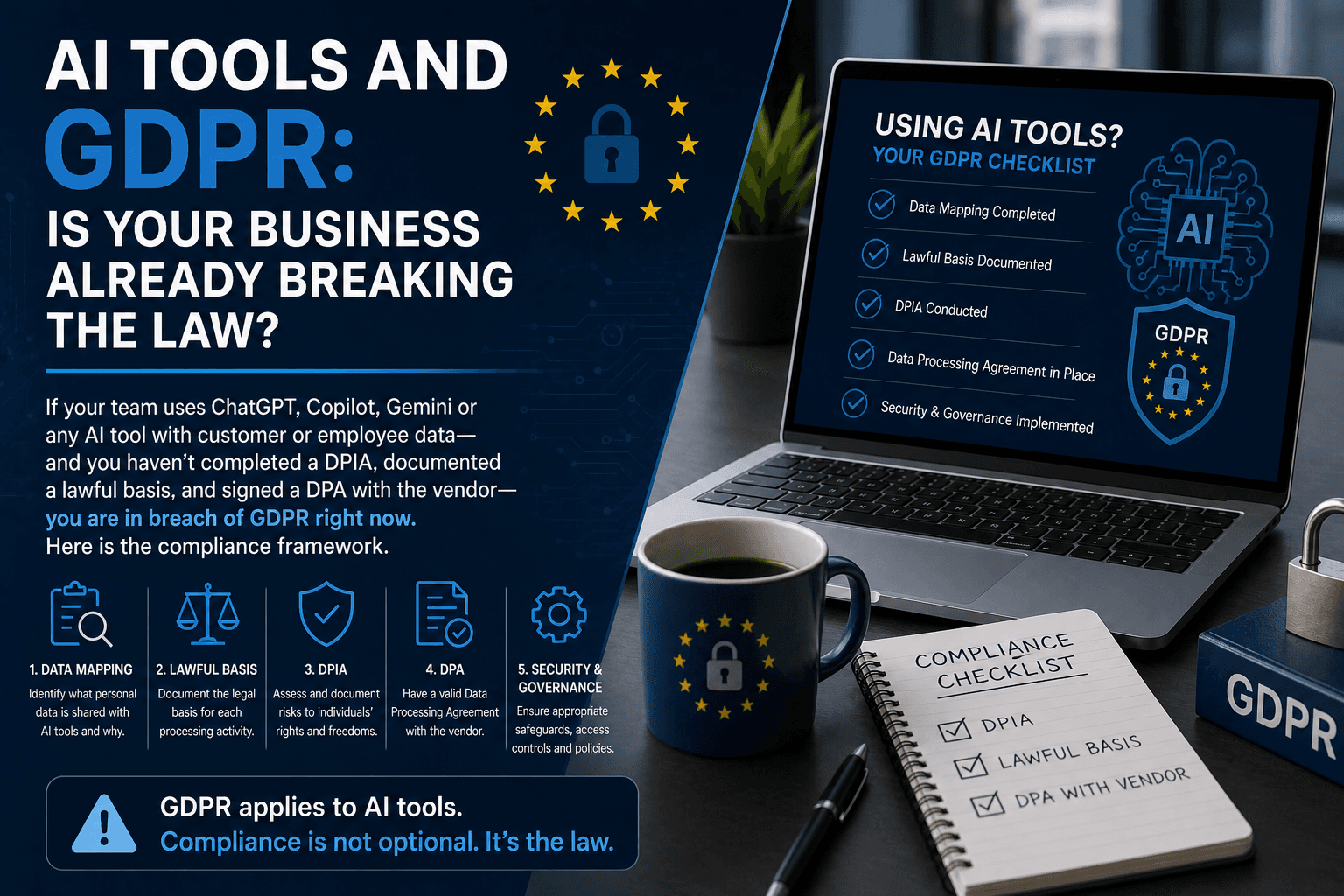
If your team uses ChatGPT, Copilot, Gemini or any AI tool with customer or employee data — and you have not completed a DPIA, documented a lawful basis, and signed a DPA with the vendor — you are in breach of GDPR right now. Here is the compliance framework.
The Compliance Crisis Hiding in Plain Sight
According to a 2026 IAPP survey, only 12% of Data Protection Officers have reviewed their AI vendor contracts for GDPR compliance. Given that AI tools are now embedded in most business workflows — from drafting emails to analysing customer data — this means the overwhelming majority of organisations using AI are doing so without adequate legal documentation.
Regulators have noticed. European supervisory authorities issued approximately €1.2 billion in GDPR fines in 2025 alone, according to DLA Piper's January 2026 survey. AI-related violations are an increasingly significant portion of that total.
Real Fines for Real AI Violations
These are not hypothetical risks:
These fines targeted the AI vendors directly. But the businesses using these tools and feeding customer or employee data into them are also exposed — because under GDPR, you (the controller) are responsible for what your processors do with your data.
The EU AI Act: A Second Layer of Obligation
The EU AI Act, in force since August 2024, adds compliance requirements that sit on top of GDPR — not instead of it. The rollout timeline:
Fines under the EU AI Act:
If your business operates in the EU and uses AI tools, you now have two parallel frameworks to comply with.
The 6 GDPR Fault Lines in AI Tool Usage
Fault Line 1: No Lawful Basis for Processing
Every time you feed personal data into an AI tool — whether customer emails, employee records, or support tickets — you are processing personal data. GDPR requires a lawful basis for every processing activity.
The common lawful bases for AI tool usage:
Processing personal data in AI tools without a documented lawful basis is a direct GDPR violation.
Fault Line 2: No Data Processing Agreement With the AI Vendor
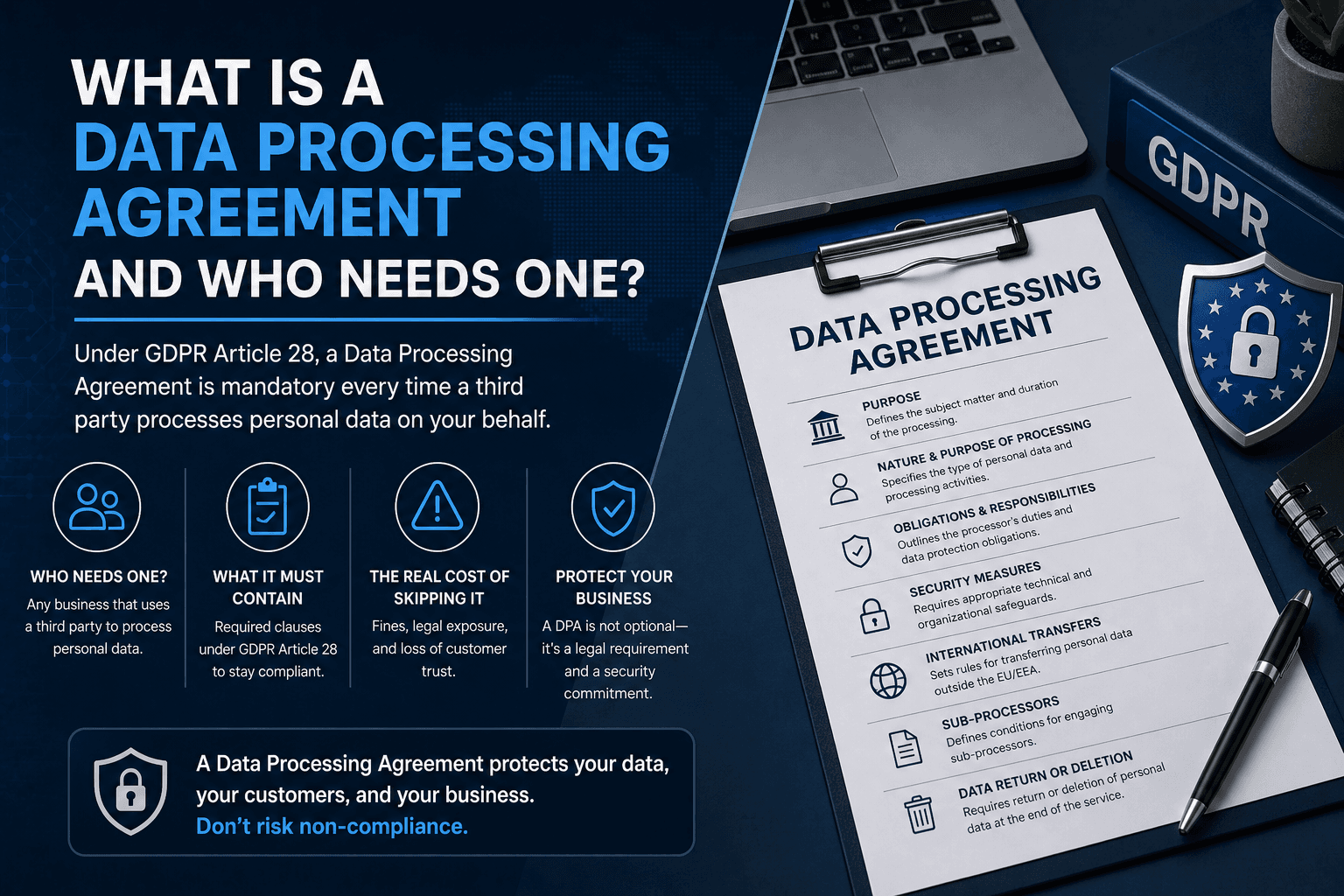
If you use ChatGPT (OpenAI), Microsoft Copilot, Google Gemini, or any AI tool that processes personal data on your behalf, the vendor is your data processor. Under GDPR Article 28, you need a DPA with them.
Most major AI vendors publish enterprise DPAs:
Critical point: If you are using the free or consumer version of these tools and feeding in customer or employee personal data, you almost certainly do not have a DPA in place and your data may be used for model training.
Fault Line 3: No Data Protection Impact Assessment (DPIA)
A DPIA is mandatory under GDPR Article 35 when processing is "likely to result in a high risk" to individuals. AI processing almost always meets this threshold because it involves:
A DPIA must:
If your organisation has deployed any AI tool that processes personal data without completing a DPIA, you are in breach of Article 35.
Fault Line 4: Data Minimisation Failures
GDPR Article 5(1)(c) requires that personal data is "adequate, relevant and limited to what is necessary" for the specified purpose. AI tools work better with more context — which directly conflicts with this principle.
When your AI tool pulls entire customer records, full conversation histories, and detailed account information to generate a response, ask yourself: is all of that personal data actually necessary?
Practical safeguards:
Fault Line 5: No Transparency to Data Subjects
Data subjects have the right to know that their data is being processed by AI systems, particularly if that processing has legal or significant effects on them. Your Privacy Policy must be updated to disclose:
A Privacy Policy written in 2022 almost certainly does not cover your current AI tool usage. This gap alone has been the basis for regulatory enforcement.
Fault Line 6: International Data Transfers via AI Tools
Most major AI tools process data on servers in the United States. Under GDPR, transferring EU personal data to the US requires an adequate transfer mechanism:
If your vendor's DPA does not include SCCs or reference the EU-US DPF, your data transfers may be unlawful — regardless of how good the rest of your compliance is.
The 5-Step AI Compliance Framework
Step 1 — Inventory your AI tools
List every AI tool your team uses that touches personal data. Include browser extensions, CRM AI features, email AI assistants, and any custom-built AI tools.
Step 2 — Upgrade to business/enterprise tiers where needed
Consumer-tier AI tools typically lack DPAs and data processing protections. Upgrade to business tiers that offer proper contractual protections before using them with personal data.
Step 3 — Sign DPAs with every AI vendor
Obtain and sign DPAs with every AI vendor on your list. Confirm sub-processor lists. Check international transfer mechanisms.
Step 4 — Complete a DPIA for each AI use case
Document the processing, assess the risks, implement mitigations. This does not need to be a 50-page document — a well-structured 3-5 page DPIA per use case is appropriate for most SMEs.
Step 5 — Update your Privacy Policy
Disclose AI tool usage, purposes, and any automated decision-making in your Privacy Policy. This is both a legal requirement and an increasingly important trust signal to customers.
The Bottom Line
Using AI tools with customer or employee data without these five steps in place is not a grey area. It is a documented GDPR violation waiting to be discovered. The question is not whether your AI tool usage is compliant — it is whether you have the documentation to prove it.
Need a DPIA template, AI data processing policy, or Privacy Policy update for AI tools? Our legal team provides AI compliance documentation packages tailored to your specific tool stack — ready in 48-72 hours.
Need Legal Documents?
Get expert-drafted legal documents customized for your business. From NDAs to GDPR policies, we've got you covered.