Partnership Agreements: Why a Handshake Deal Will Destroy Your Business
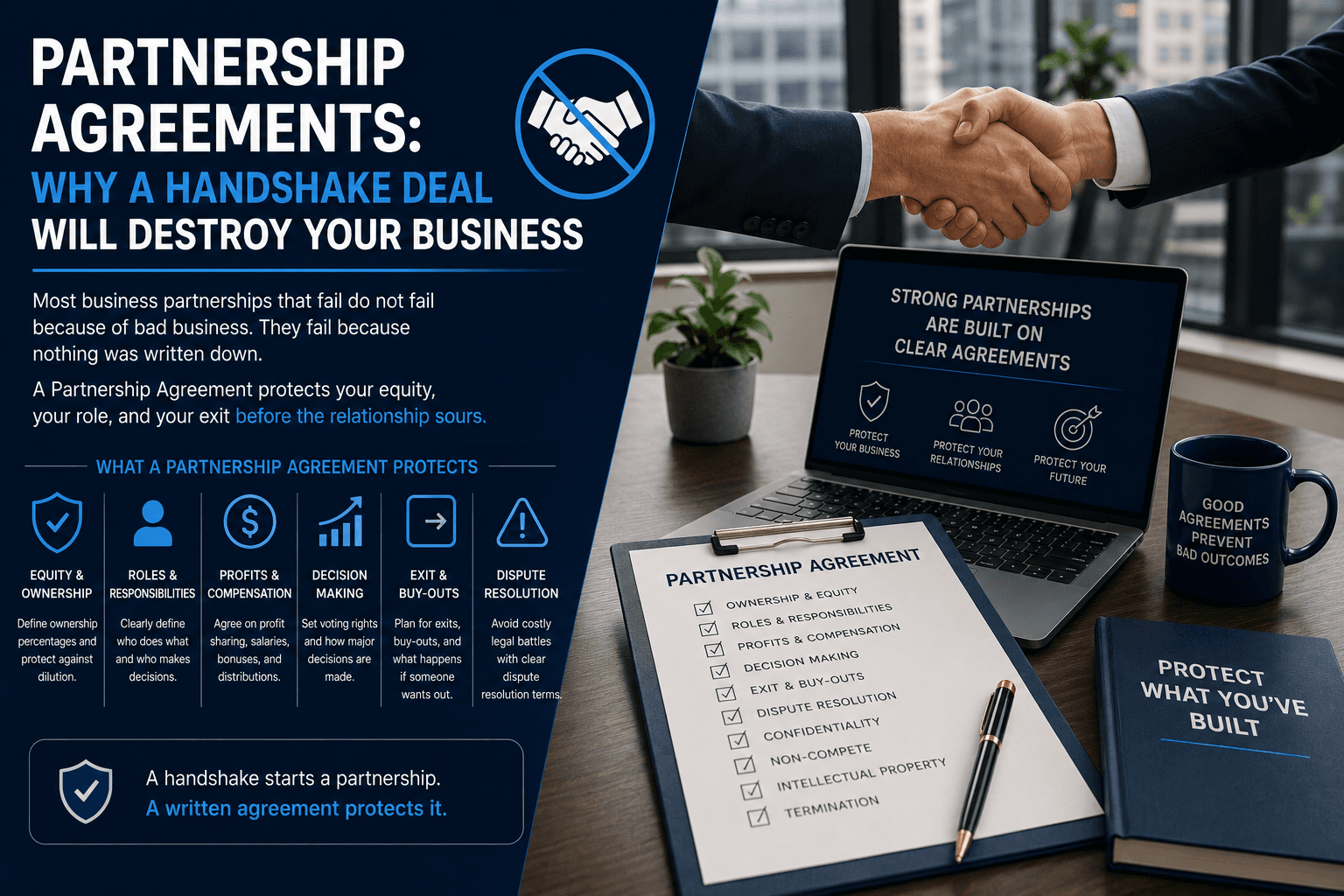
Most business partnerships that fail do not fail because of bad business. They fail because nothing was written down. A Partnership Agreement protects your equity, your role, and your exit — before the relationship sours.
The Most Expensive Document You Are Not Signing
Two friends start a business. Things go well for two years. Then one partner stops contributing, the other carries the load. The first demands 50% of profits anyway. There is no written agreement. Neither can force the other out. The business — and the friendship — collapse in litigation.
This story plays out thousands of times every year. The tragedy is not the falling out. It is that a well-drafted Partnership Agreement, written at the start when everyone was optimistic, would have resolved every one of these disputes in advance.
What Is a Partnership Agreement?
A Partnership Agreement (also called a Business Partnership Agreement or Shareholders Agreement, depending on structure) is a legally binding contract between two or more business partners that defines:
Without this document, partnerships in most jurisdictions (including Cyprus, the UK, and most EU member states) are governed by default statutory rules — which rarely reflect what the partners actually intended and almost never protect either party fairly.
The 9 Clauses Every Partnership Agreement Must Contain
1. Ownership and Capital Contributions
Start with the most fundamental question: who owns what?
The agreement must state:
The common mistake: Starting with a 50/50 split because it feels fair. Equality sounds good when everything is going well. When there is a deadlock — and there will eventually be a deadlock — 50/50 gives you no mechanism to break it without external intervention (expensive arbitration or court proceedings).
Consider carefully whether a 51/49 split, or a tiered voting structure, better reflects the actual decision-making authority you intend.
2. Roles, Responsibilities and Time Commitment
Define what each partner actually does in the business:
The "he's not doing his share" dispute is the most common source of partnership breakdown. If the agreement defines responsibilities and minimum effort clearly, this dispute either never starts or resolves immediately by reference to the contract.
3. Profit and Loss Distribution
How does money flow out of the business?
The agreement must specify:
Partnership-specific legal note: In a general partnership (as distinct from a limited company), partners may have unlimited personal liability for partnership debts under the laws of many jurisdictions including Cyprus and the UK. The agreement should address this and, in most cases, incorporation as a limited company is a better structure if significant liabilities are anticipated.
4. Decision-Making Authority
Not all decisions should require unanimous consent. Define three tiers:
Day-to-day decisions — any partner can make these independently (routine purchases under a threshold, operational choices, standard client correspondence)
Significant decisions — require majority approval (hiring key staff, entering contracts above a defined value, marketing strategy changes)
Major decisions — require unanimous consent (taking on debt or investment, selling the business, admitting a new partner, changing the business model, distributing large profits)
The absence of a decision-making framework is what creates deadlocks. When two 50/50 partners disagree on a major decision, the business literally cannot move forward without this clause.
5. New Partners and Share Transfers
What happens if a partner wants to bring in someone new — or sell their stake?
Right of first refusal: Before a partner can sell their ownership stake to an outsider, they must first offer it to the existing partners at the same price and terms. This prevents the nightmare scenario of waking up to discover your business partner has sold their stake to a stranger.
Admission of new partners: Any new partner must be approved unanimously (or by a defined supermajority). Define what documentation is required and how their ownership stake will be structured.
Tag-along and drag-along rights:
6. Partner Exit — Voluntary and Involuntary
This is the clause most partnerships never discuss at the start — and the one that matters most when things go wrong.
Voluntary exit:
Involuntary exit (the "bad leaver" scenario):
What happens if a partner must be removed because of:
A "bad leaver" clause typically allows the business to repurchase the departing partner's stake at a reduced valuation (or even at cost) to reflect the damage their departure or conduct causes. Without this clause, a partner who commits misconduct can demand full fair market value for their stake as a condition of leaving.
Death or permanent incapacity:
What happens to a deceased partner's stake? Does it pass to their estate (potentially bringing in an unknown heir as a partner)? Is there a buyout obligation? This must be addressed explicitly.
7. Non-Compete and Non-Solicitation
A departing partner who then sets up a competing business using knowledge and relationships they gained as your partner is the single most damaging exit scenario.
Your agreement should include:
These clauses must be reasonable to be enforceable — courts will not uphold a worldwide, 10-year non-compete for a junior partner. Work with a lawyer to ensure the restrictions protect legitimate business interests without overreaching.
8. Dispute Resolution
Even the best partnerships have disagreements. Define a tiered process:
Tier 1 — Internal negotiation: Partners must attempt to resolve the dispute in good faith through direct discussion, with a defined cooling-off period (e.g. 14 days)
Tier 2 — Mediation: If internal resolution fails, an accredited third-party mediator is appointed jointly. Mediation is significantly cheaper and faster than litigation.
Tier 3 — Arbitration or litigation: If mediation fails, define whether disputes go to arbitration (private, confidential, potentially faster) or court proceedings, and specify the governing law and jurisdiction.
The dispute resolution clause does not prevent disputes — it provides a road map for resolving them without destroying the business in the process.
9. Dissolution
What happens when the partnership ends — planned or otherwise?
The agreement must address:
The Right Time to Sign a Partnership Agreement
The right time is before you start. The second best time is right now.
Partnerships are easiest to document at the beginning, when optimism is high and no disputes have yet arisen. Once a relationship starts to sour, agreeing on the terms of a partnership document becomes much harder — and by that point, you usually need it urgently.
If you have a business partner and no written agreement, you are operating with unlimited exposure. Everything that is not written down is an argument waiting to happen.
Need a Partnership Agreement drafted for your business? Our legal experts draft partnership and shareholders agreements tailored to your specific ownership structure, industry, and jurisdiction — delivered in 48-72 hours.
Need Legal Documents?
Get expert-drafted legal documents customized for your business. From NDAs to GDPR policies, we've got you covered.