Terms of Service for SaaS: What Must Be in Yours
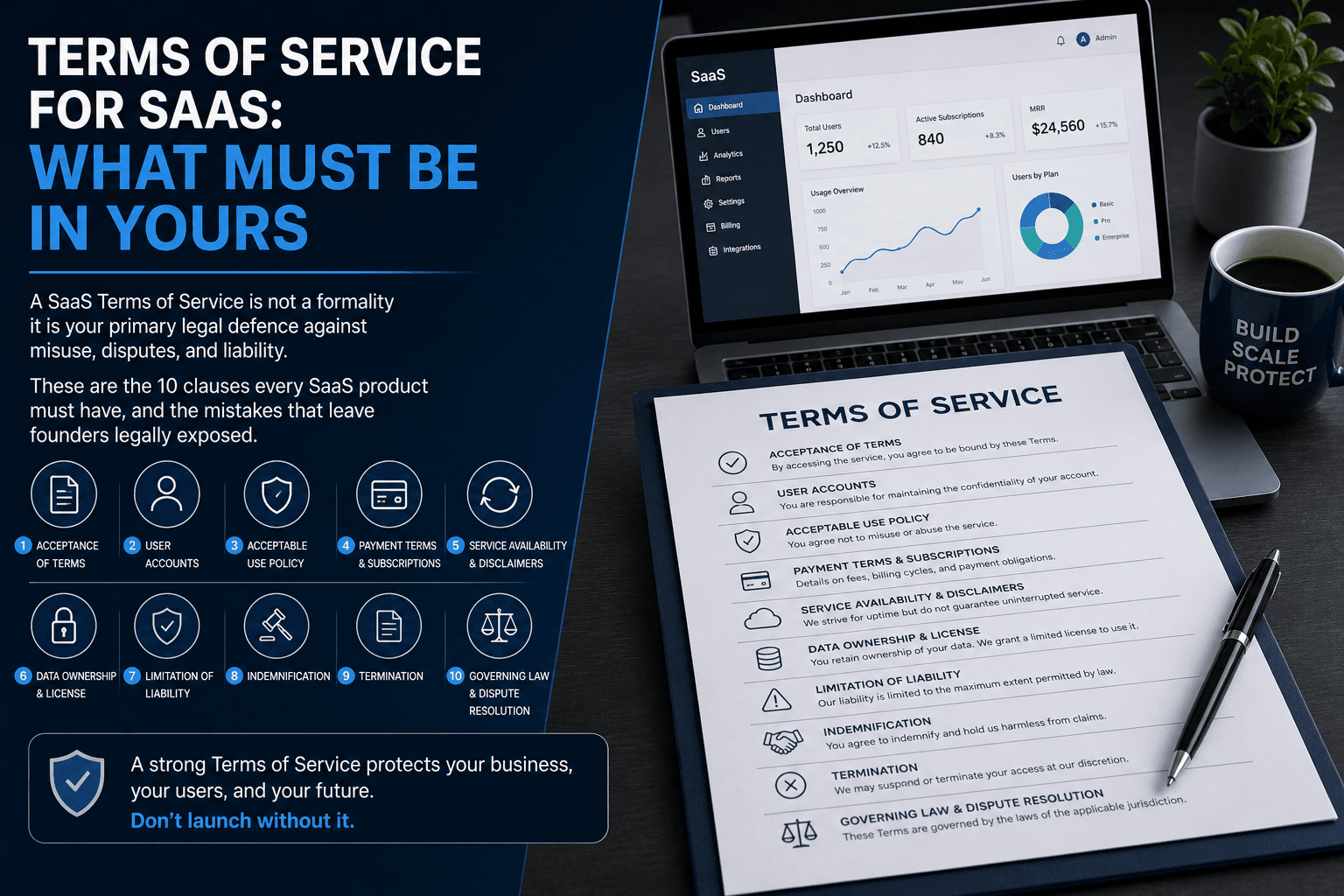
A SaaS Terms of Service is not a formality — it is your primary legal defence against misuse, disputes, and liability. These are the 10 clauses every SaaS product must have, and the mistakes that leave founders legally exposed.
Why Your SaaS Terms of Service Is Your Most Important Contract
Every time a user clicks "I agree," they are entering a legally binding contract with your company. That contract is your Terms of Service (ToS) — and for SaaS companies, it governs your entire commercial relationship with every customer.
Done right, your ToS:
Done wrong — or not done at all — a single enterprise customer dispute can expose your company to damages that dwarf your annual revenue.
Who Needs a SaaS-Specific ToS?
Any company that:
A generic "website terms" template is not adequate for a SaaS product. SaaS ToS must address subscription billing, service availability, data handling, and multi-seat licensing — none of which appear in standard website terms.
The 10 Essential SaaS ToS Clauses
1. Scope of License
Your ToS must precisely define what users are permitted to do with your software. A SaaS licence is not a purchase — it is a limited, non-exclusive, non-transferable right to access and use the service.
The licence clause must specify:
Without a clear licence scope, you have no contractual basis to prevent a competitor from using your product to build against you.
2. Subscription, Billing and Auto-Renewal
This clause is legally critical in many jurisdictions. It must clearly state:
EU-specific note: Under EU Consumer Rights Directive, if you sell to consumers (not just businesses), you may have mandatory 14-day withdrawal rights obligations. B2B SaaS typically avoids this but verify your customer base.
3. Acceptable Use Policy (AUP)
Your AUP defines what users cannot do with your service. It is the foundation of your right to suspend or terminate accounts. It must explicitly prohibit:
Without a clear AUP, you have no contractual basis to terminate a user who is misusing your platform — leaving you exposed to both liability and operational disruption.
4. Service Availability and SLA
SaaS customers increasingly expect uptime guarantees. Your ToS must address service availability honestly and protect you from liability for downtime you cannot control:
For enterprise SaaS with formal SLA commitments, these provisions become a separate SLA document — but the ToS must still address the baseline availability position.
5. Intellectual Property Ownership
Two IP positions must be crystal clear:
Your IP:
The service, its underlying technology, interface, trademarks, and all content you create remain your exclusive property. Users receive a licence to use — not any ownership rights.
User content:
Content that users create, upload, or generate within your platform (documents, data, custom configurations) remains the user's property. You require a limited licence to host, process, and display that content as necessary to provide the service.
This is the clause that prevents a disgruntled departing customer from claiming they own the software configuration they built in your product.
6. Data Processing and Privacy
Your ToS must cross-reference your Privacy Policy and, for B2B SaaS specifically, address the GDPR controller-processor relationship:
GDPR requirement: If your SaaS processes personal data on behalf of your business customers, you are a data processor and must offer a GDPR-compliant DPA. This is non-negotiable for selling to EU businesses.
7. Limitation of Liability
Without this clause, your exposure is theoretically unlimited. With it, your liability is capped at a manageable amount.
A standard SaaS limitation of liability:
EU/UK note: Consumer protection laws limit the extent to which you can exclude liability for negligence or defective products with B2C customers. These clauses are most effective in B2B contexts.
8. Termination Rights
Define when and how either party can end the relationship:
9. Dispute Resolution and Governing Law
Specify:
For US-focused SaaS: arbitration clauses and class action waivers are common. For EU-focused SaaS: arbitration clauses are less standard and their enforceability varies by jurisdiction.
10. Changes to the Terms
You will need to update your ToS as your product evolves. Reserve the right to do so:
Courts have scrutinised "we may change these terms at any time without notice" clauses — they are increasingly unenforceable in consumer contexts and increasingly unpopular with enterprise buyers.
The Clickwrap vs Browsewrap Question
Clickwrap — users must actively tick a box or click "I Agree" to proceed. This creates clear evidence of consent and is enforceable in virtually all jurisdictions.
Browsewrap — a notice at the bottom of the page says "by using this site you agree to our terms." This is widely considered insufficient and has been repeatedly struck down in court.
For any SaaS with subscription billing or significant liability exposure: use clickwrap. Require users to actively check a box confirming they have read and agreed to your ToS before account creation is complete.
Start with These Three Documents Together
A complete SaaS legal foundation requires:
Launching a SaaS product without all three in place is launching without your legal foundation. Every customer you acquire before these are in place is a customer acquired without a governing contract.
Need a SaaS Terms of Service, Privacy Policy, and DPA package? Our legal team drafts complete SaaS legal documentation customised to your product, pricing model, and target markets — delivered in 48-72 hours.
Need Legal Documents?
Get expert-drafted legal documents customized for your business. From NDAs to GDPR policies, we've got you covered.