Remote Work Legal Issues in 2026: Contracts, Tax and Data Protection
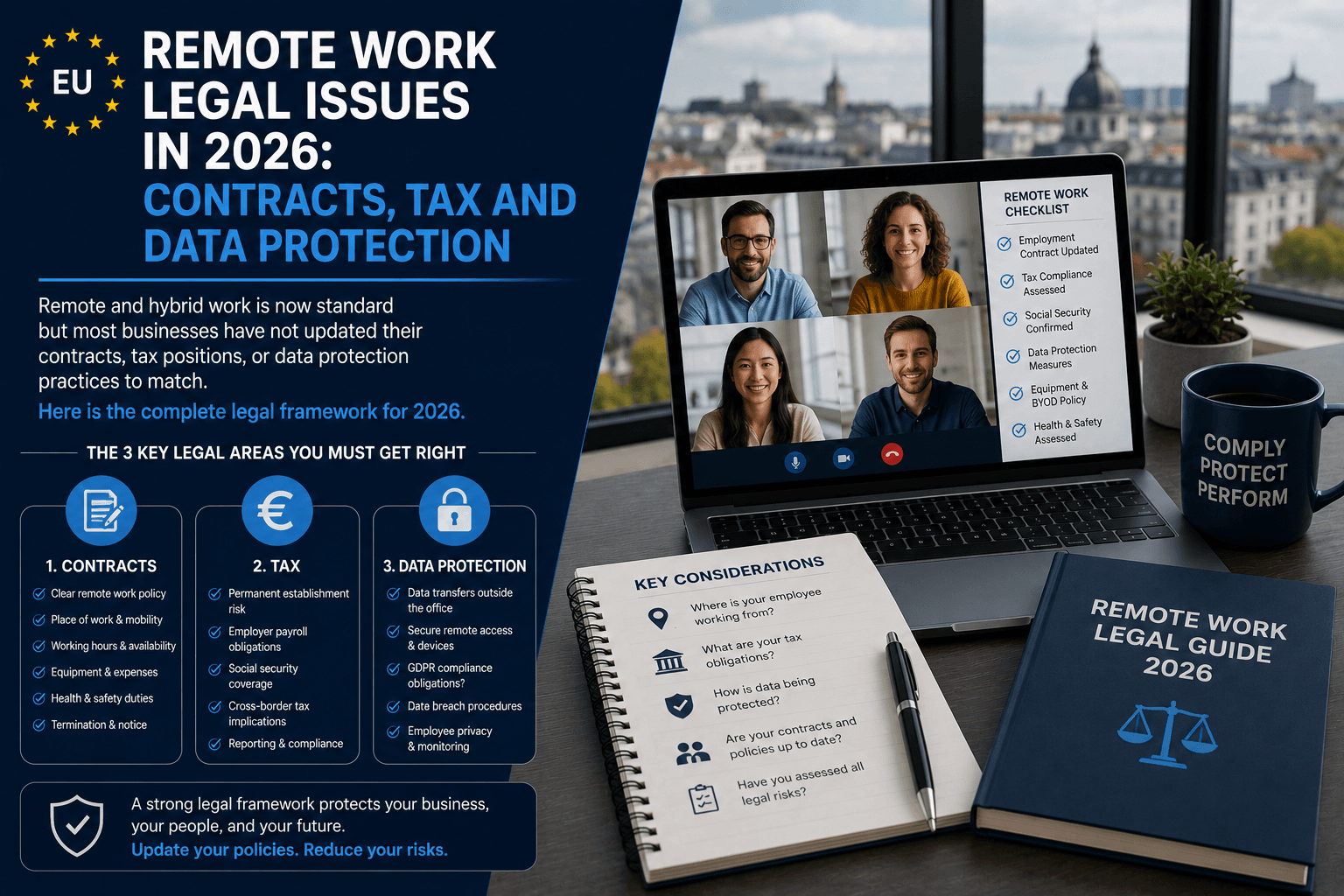
Remote and hybrid work is now standard — but most businesses have not updated their contracts, tax positions, or data protection practices to match. Here is the complete legal framework for 2026.
Remote Work Is Now a Legal Minefield — and Most Businesses Are Walking Through It Blind
Remote work became the norm almost overnight. The legal framework for remote work has been catching up ever since — slowly, inconsistently, and across multiple different regulatory areas simultaneously.
In 2026, employers with remote or hybrid teams face obligations across three distinct areas: employment contracts, tax and permanent establishment risk, and data protection. A gap in any one of them creates legal exposure.
Part 1: Employment Contracts for Remote Workers
What Must Be in a Remote Work Contract
A standard employment contract written before 2020 almost certainly does not address remote work adequately. For remote or hybrid workers, your contract must now explicitly cover:
Place of work
The contract must state the designated remote work location (typically the employee's home address or a specified country/region). For hybrid workers, state both the office address and the permitted remote work location.
Equipment and expenses
Who provides the equipment? Who pays for home internet? EU law and many national laws (including Cyprus Labour Law) require employers to cover costs that employees would not have incurred if working in the office. Leave this undefined and you face retrospective claims.
Working hours and availability
Remote work arrangements must specify:
Right to Disconnect
Several EU member states have introduced or are introducing Right to Disconnect legislation, giving employees the legal right not to respond to work communications outside working hours. Even where not yet mandated by national law, addressing this in your contract reduces disputes and demonstrates compliance intent.
Health and safety obligations
Employers remain responsible for the health and safety of remote workers. The contract should confirm that the employer's H&S policy extends to the remote workspace and that employees must report any H&S concerns.
Data security at home
Remote workers accessing company systems and client data from home must comply with your data security policies. The contract must reference these policies and confirm the employee's obligation to maintain a secure working environment.
The Framework Agreement on Cross-Border Telework (EU)
Since July 2023, the EU Framework Agreement on Cross-Border Telework allows employees who work remotely from another EU member state to remain in the social security system of their employing country — provided that remote work in the country of residence represents less than 50% of total working time.
Without this framework:
Practical requirement: If any of your employees work remotely from an EU country that is not your company's country of registration, you need an A1 certificate from your social security authority to confirm which country's social security rules apply.
Part 2: Tax and Permanent Establishment Risk
The OECD's November 2025 Update
In November 2025, the OECD published its first major update to the Model Tax Convention since 2017, introducing new guidance on when remote workers create a taxable presence — a "Permanent Establishment" (PE) — for their employer in another country.
The 50% Threshold Rule (new)
Under the updated guidance, if an employee works from a location for less than 50% of their total working time over any 12-month period, that location will generally not be treated as a fixed place of business creating a PE for the employer.
This is significant relief: an employee who spends 3-4 months per year working remotely from another country is unlikely to create a PE under this new threshold.
What still creates PE risk:
Tax residency of the employee (183-day rule)
Separately from PE risk, employees who spend more than 183 days in a foreign country in a tax year may become tax resident in that country — triggering income tax obligations in the host country and potentially ending their tax residency in the home country.
Practical steps:
The Cyprus Angle
Cyprus's 60-day residency rule (establishing tax residency by spending just 60 days in Cyprus) means that employees and founders can legitimately structure their tax affairs around Cyprus residency — but this requires genuine substance and compliance with day-count rules. If employees are nominally Cyprus-based but primarily working from another country, both the employee's residency position and the company's PE position may be challenged.
Part 3: Data Protection for Remote Workers
GDPR Obligations That Change With Remote Work
GDPR does not stop at the office door. When employees work remotely, several specific obligations apply:
Employee monitoring
Many employers use monitoring tools for remote workers: time-tracking software, screen capture, keystroke logging, website monitoring. Under GDPR, employee monitoring must:
Covert monitoring of employees is almost universally a GDPR violation. Courts and DPAs consistently find that surveillance conducted without disclosure fails the transparency and proportionality tests.
Home network security
When employees access company systems from home networks, personal devices introduce data protection risks that do not exist in a controlled office environment. Your remote work policy (referenced in the employment contract) must require:
Data breach risk increases with remote work
The ICO and European DPAs have reported a significant increase in data breaches linked to remote working — primarily through phishing attacks targeting home workers and the use of unsecured personal devices.
Your Incident Response Plan must address remote work breach scenarios specifically, including how to remotely lock or wipe company devices if lost or stolen.
Cross-border data transfers within remote teams
If you employ remote workers in different countries and those workers access databases containing personal data, this may constitute an international transfer of personal data under GDPR. Check whether your data flows across borders and whether appropriate transfer mechanisms are in place.
The Remote Work Policy Document
Every business with remote or hybrid workers should have a standalone Remote Work Policy that addresses:
This document does not replace the employment contract — it supplements it. Both documents should cross-reference each other.
The 2026 Remote Work Legal Checklist
Need a remote work employment contract, Remote Work Policy, or GDPR employee privacy notice? Our legal team provides complete remote work documentation packages — tailored to your team structure and jurisdictions — delivered in 48-72 hours.
Need Legal Documents?
Get expert-drafted legal documents customized for your business. From NDAs to GDPR policies, we've got you covered.