How to Write a GDPR-Compliant Privacy Policy in 2026
A Privacy Policy that does not accurately reflect your actual data practices is worse than no policy at all — it is evidence against you in a regulatory investigation. This step-by-step guide covers every element a 2026-compliant Privacy Policy must contain.
The Privacy Policy Is Not a Formality — It Is a Legal Statement
Every Privacy Policy on the internet is a formal declaration to regulators, customers, and courts about what your organisation does with personal data. When your Privacy Policy says one thing and your actual practices say another, regulators treat that gap as an aggravating factor — evidence that you knew about your obligations and chose to misrepresent them.
A copied template, a generic generator output, or a policy written for a different business does not protect you. It creates exposure.
This guide covers every mandatory element of a GDPR-compliant Privacy Policy in 2026 — and the common drafting mistakes that make policies legally worthless.
Step 1: Conduct a Data Audit First
Before writing a single word of your Privacy Policy, map your actual data practices:
What data do you collect?
List every type of personal data: names, email addresses, phone numbers, IP addresses, cookie identifiers, payment data, location data, device identifiers, behavioural data, account credentials, biometric data, health data, etc.
How do you collect it?
Why do you process each type of data?
For each data category, identify the specific purpose: fulfilling orders, sending marketing emails, fraud prevention, customer support, analytics, legal compliance, etc.
Who do you share it with?
List every third party that receives personal data: email platforms, payment processors, shipping providers, analytics tools, advertising platforms, CRM systems, cloud hosting providers, customer support software.
Where is it stored?
Identify whether data is processed within the EU/EEA, in the UK, or in third countries (US, etc.).
How long do you keep it?
Define retention periods for each data category: active customers, inactive customers, transaction records, marketing lists, support tickets, audit logs.
Your Privacy Policy must reflect this audit accurately. If your audit reveals you collect data you cannot justify, stop collecting it — then write the policy.
Step 2: Structure Your Privacy Policy
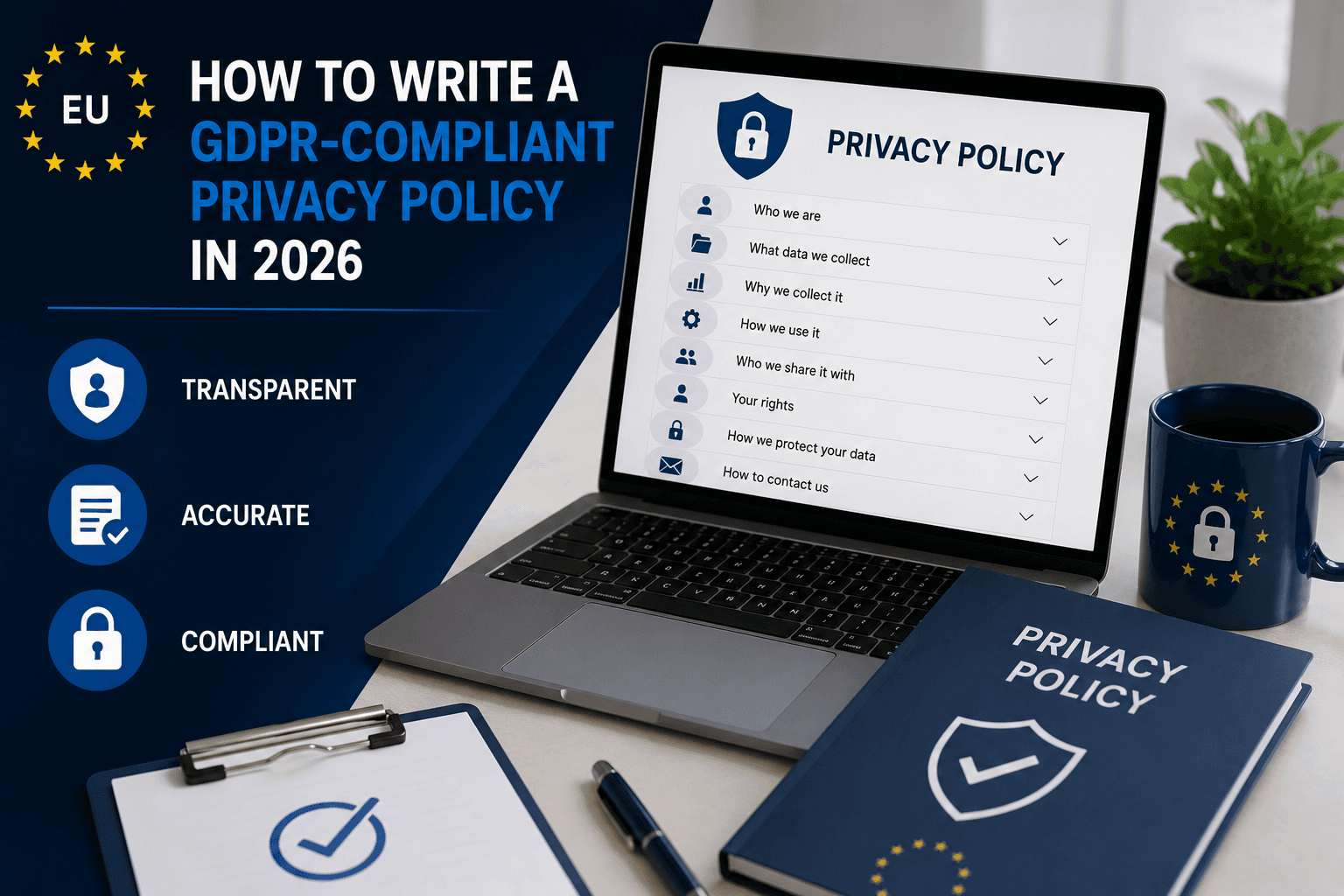
A compliant Privacy Policy should be structured logically, using clear headings that allow readers to find the information relevant to them. Recommended structure:
Step 3: Write Each Section — What It Must Contain
1. Who We Are (Identity of the Data Controller)
Under GDPR Articles 13 and 14, you must provide:
Common mistake: Listing a trading name instead of the registered company name, or providing a generic info@ email without a DPO-specific contact where one is required.
2. What Data We Collect
List every category of personal data you collect, grouped logically:
The GDPR language trap:
Regulators have specifically identified these phrases as non-compliant because they are too vague:
Each of these must be replaced with specific, concrete descriptions of what data, why, which third parties, and how long.
3. Why We Process Your Data — Purposes and Lawful Bases
This is the most technically demanding section. For every processing activity, you must state both the purpose and the lawful basis under GDPR Article 6.
The six lawful bases are:
Matching purpose to basis — practical examples:
| Processing Activity | Correct Lawful Basis |
|--------------------|---------------------|
| Fulfilling an order | Contract |
| Sending order confirmation | Contract |
| Fraud prevention | Legitimate interests |
| Sending marketing emails to existing customers | Soft opt-in (ePrivacy) + legitimate interests |
| Sending marketing emails to new subscribers | Consent |
| Legal record-keeping (tax records) | Legal obligation |
| Google Analytics tracking | Consent |
| Meta Pixel advertising tracking | Consent |
For legitimate interests processing: Your Privacy Policy must explain what the legitimate interest is and confirm that you have assessed it against the rights of data subjects (a Legitimate Interests Assessment, kept internally).
4. Who We Share Your Data With
Name every third party that receives personal data, or describe them by category:
Vague phrases like "trusted third-party partners" are specifically criticised by DPAs and should not be used.
5. International Data Transfers
If any third party you share data with processes it outside the EU/EEA or UK, you must disclose this and state the safeguard:
Most major platforms (Google, Meta, Stripe, AWS) rely on SCCs or the EU-US DPF. Check each vendor's DPA to confirm the mechanism they use and state it in your Privacy Policy.
6. Data Retention Periods
State a specific retention period for each category of data — not "as long as necessary" which is explicitly non-compliant:
7. Data Subject Rights
Under GDPR Articles 15-22, individuals have the following rights — all must be listed and explained:
For each right, state how to exercise it (email address, online form, or both) and confirm you will respond within one month (the GDPR deadline).
Also confirm the right to lodge a complaint with the relevant supervisory authority:
8. Changes to This Privacy Policy
State how users will be notified of changes (email notification, website banner, or updated "last modified" date) and confirm that continued use of the service after notification constitutes acceptance of the updated policy.
Include a "Last Updated" date at the top of the policy — and actually update it every time your data practices change.
The Most Common Privacy Policy Failures
Failure 1 — Policy describes a different business
Copied from a template or another site; lists data types, tools, and purposes that don't apply to your business.
Failure 2 — Missing lawful basis for key processing activities
Particularly for marketing emails, analytics, and advertising pixels — many policies simply say "we process your data" without stating the legal basis.
Failure 3 — Vague retention periods
"We retain your data for as long as necessary" is non-compliant. Specific periods are required.
Failure 4 — Third parties not named
"We share your data with partners" without identifying who those partners are fails the transparency requirement.
Failure 5 — Not updated when tools change
Adding Google Analytics, Meta Pixel, or any new third-party tool without updating the Privacy Policy creates a documented gap between stated policy and actual practice.
Failure 6 — Wrong contact details
A DPO email address that bounces, a postal address that is no longer current, or no mechanism for exercising rights.
The Final Checklist
Before publishing your Privacy Policy, verify:
Need a Privacy Policy drafted to reflect your actual data practices? Our legal team writes Privacy Policies based on a detailed review of your website, tools, and data flows — not from a template. Delivered in 24-72 hours with ongoing update support.
Need Legal Documents?
Get expert-drafted legal documents customized for your business. From NDAs to GDPR policies, we've got you covered.