Shareholder Agreements: Protecting Your Equity From Day One
A Shareholders Agreement is the most important document a startup never signs. It governs what happens to your equity in every scenario — investment, departure, dilution, dispute, and exit. Here is what every clause must cover and why.
The Document That Determines Who Owns Your Company
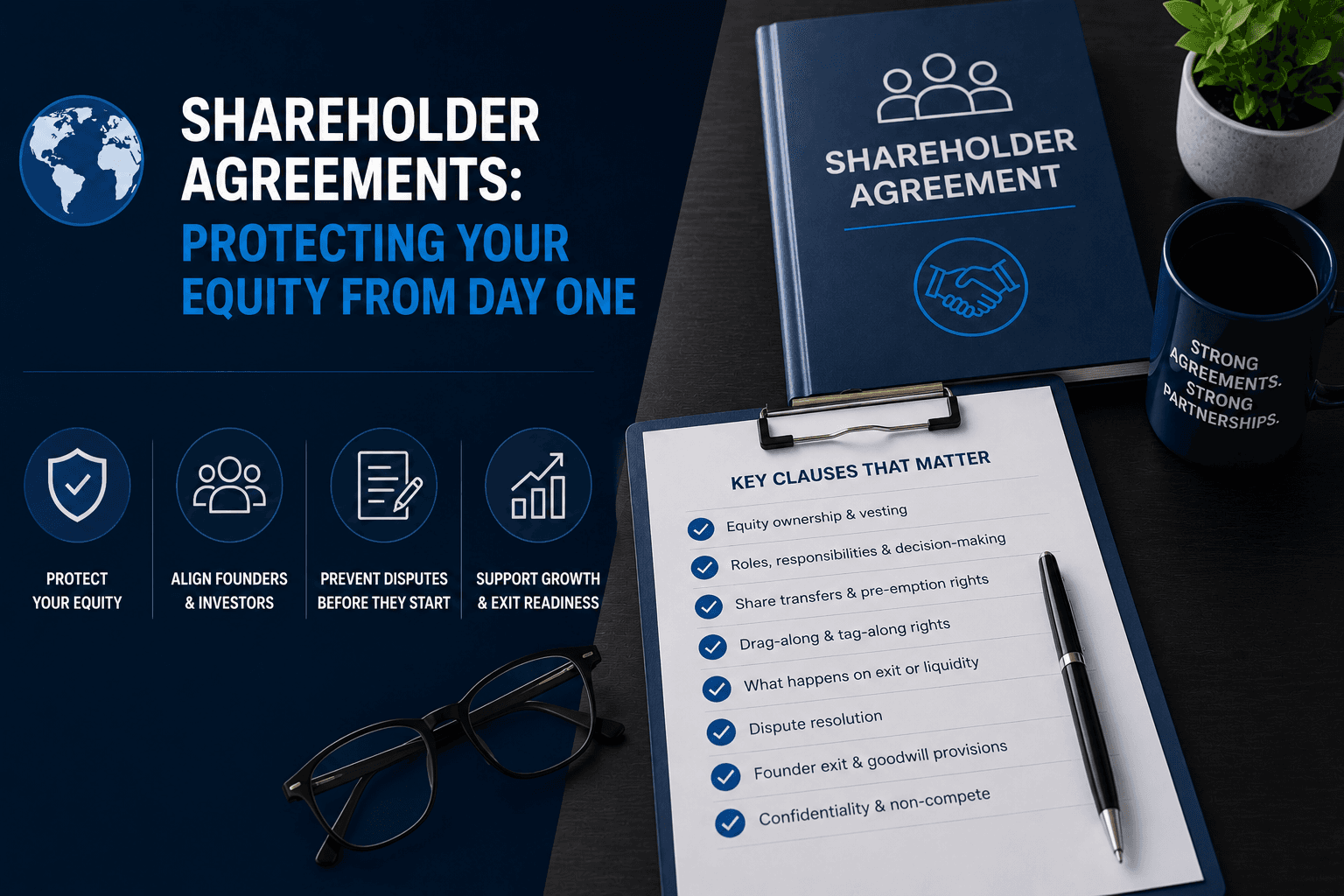
A company's Articles of Association set out its basic governance rules. A Shareholders Agreement does something more important: it governs the private relationship between shareholders — the rules that determine who controls the company, who can sell their shares, how founders are protected, and what happens when things go wrong.
Most early-stage companies rely entirely on their Articles of Association. This leaves critical questions unanswered:
Every one of these questions has a default answer under company law — and the default answer is almost never what the founders intended.
A Shareholders Agreement replaces those defaults with terms you have actually agreed. It is confidential (unlike the Articles, which are public), flexible, and enforceable between the parties.
When You Need a Shareholders Agreement
At incorporation (always, if there are multiple shareholders)
The easiest time to draft a Shareholders Agreement is before anyone has anything to fight about. At founding, all parties are motivated to be fair and clear. The document is produced quickly and cheaply.
Before the first external investment
Any external investor will require a Shareholders Agreement as a condition of investment — and they will bring their own template that protects their interests, not yours. Understanding what you are signing before an investor's lawyer puts it in front of you is essential.
When a key employee receives equity
Employee share schemes and vesting arrangements must be governed by a Shareholders Agreement — or at minimum by a deed of adherence to an existing one.
When adding a new co-founder later
Adding a co-founder mid-journey without documenting the equity arrangement is a significant legal and commercial risk. A Shareholders Agreement formalises the arrangement before the relationship becomes difficult.
The Core Clauses Every Shareholders Agreement Must Contain
1. Share Ownership and Capital Structure
The starting point: who owns what.
The agreement must document:
Share classes in practice:
Early-stage investor rounds often introduce preference shares that carry rights ordinary shares do not have — liquidation preference, dividend priority, conversion rights. The Shareholders Agreement must describe these clearly. If you sign an investment agreement without fully understanding the liquidation preference, you may discover in an exit that the investor receives 2x their investment before you receive anything.
2. Founder Vesting
This is the clause founders most frequently resist — and most frequently regret not having.
Founder vesting means that a founder's equity is not fully owned from day one. Instead, it vests (becomes fully owned) over a defined period — typically 4 years with a 1-year cliff. The cliff means no equity vests until the founder has served 12 months; after that, equity vests monthly or quarterly until fully vested.
Why vesting protects everyone:
If a co-founder leaves after 6 months and takes 30% of the company with them, that departed founder's equity stake becomes a permanent drag on the business. It discourages future investment (investors see a large chunk owned by someone who contributes nothing) and may need to be bought back expensively.
With vesting:
Acceleration provisions:
Vesting agreements often include acceleration clauses — where unvested equity vests immediately in certain circumstances:
3. Investor Consent Matters (Reserved Matters)
Investors — even minority investors — frequently negotiate the right to veto certain decisions. The Shareholders Agreement will list these "reserved matters" or "consent matters": decisions the company cannot take without investor approval.
Common reserved matters include:
The founder protection: Keep the reserved matters list as narrow as possible. Overly broad reserved matters give investors veto power over ordinary business decisions and slow the company down. Push back in negotiation on anything that could affect day-to-day operations.
4. Information Rights
Investors typically require rights to financial information:
Information rights are generally reasonable and help maintain investor confidence. The Shareholders Agreement should specify the format and timing of these reports and confirm what constitutes confidential information.
5. Share Transfer Restrictions
Control who can own shares in your company by restricting transfers:
Right of first refusal (ROFR):
Before a shareholder can sell shares to any third party, they must first offer those shares to existing shareholders at the same price and on the same terms. This prevents unwanted new shareholders from appearing and gives existing shareholders the opportunity to maintain their proportionate ownership.
Pre-emption rights on new issuances:
Before issuing new shares, existing shareholders must be offered the opportunity to subscribe for a pro-rata portion of the new shares at the same price. This prevents dilution without consent.
Consent to transfer:
Some agreements require board or shareholder consent for any transfer of shares — ensuring no new shareholder enters without approval.
6. Drag-Along Rights
A drag-along clause allows a defined majority (typically holders of more than 75% of shares) to force all other shareholders to sell their shares in an acquisition, on the same terms as the majority.
This is critical for exit mechanics: if a buyer wants 100% of the company (as most trade buyers do), a minority shareholder holding even 1% cannot block the sale by refusing to sell. Without drag-along, any shareholder — no matter how small their stake — can hold a deal hostage.
The floor price protection:
Well-drafted drag-along clauses include a minimum price floor below which the drag cannot be exercised, protecting minority shareholders from being forced to sell at an unreasonably low valuation.
7. Tag-Along Rights
The mirror of drag-along: a tag-along clause gives minority shareholders the right to participate in a sale by a majority shareholder on the same terms.
If your major shareholder sells their entire stake to a buyer, tag-along rights ensure you can also sell your stake at the same price per share — rather than being left as a minority shareholder in a company now controlled by strangers.
8. Anti-Dilution Protections
When a company raises money at a lower valuation than the previous round (a "down round"), earlier investors who paid a higher price per share suffer dilution of their economic interest. Anti-dilution provisions protect against this.
Full ratchet anti-dilution: Adjusts the conversion price of earlier shares to match the new (lower) price. Very founder-unfriendly — significantly dilutes founders and other investors.
Weighted average anti-dilution: Adjusts the conversion price based on a formula that accounts for the size of the new round. More balanced and the market standard for most VC-backed deals.
Broad-based vs narrow-based weighted average: Broad-based (including all fully diluted shares in the formula) is more founder-friendly; narrow-based (excluding option pools and convertibles) is more investor-friendly.
9. Liquidation Preference
On a sale or liquidation, who gets paid first and how much?
Non-participating preference: Investors receive the higher of (a) their investment back (often with a defined multiple) or (b) their pro-rata share of proceeds if they convert to ordinary shares. Founder-friendly.
Participating preference: Investors receive their investment back first AND then participate pro-rata in the remaining proceeds as if they had converted. Much more investor-friendly — and very dilutive to founders in modest exit scenarios.
Preference multiples: A 1x preference means investors get their money back before anyone else receives anything. A 2x preference means investors receive twice their investment before distributions to other shareholders. In a modest exit, this can leave founders with significantly less than their share percentage implies.
Understanding the liquidation preference before signing an investment agreement is critical — the economic outcome in an exit depends heavily on these terms.
10. Exit Provisions and IPO Rights
What happens when the company is sold or lists on a stock exchange?
11. Confidentiality and Non-Compete
Confidentiality: All shareholders must keep confidential information about the company private. This applies to financial information, business strategy, and any personal data accessed in the course of their shareholder relationship.
Non-compete: Founders and key shareholder-employees are typically restricted from starting or joining competing businesses for a defined period — usually while they are shareholders and for 12-24 months after ceasing to be shareholders.
Non-solicitation: Restrictions on hiring the company's employees or approaching its customers for a defined period post-exit.
12. Dispute Resolution
Define a tiered process:
Governing law for Cyprus companies:
Cyprus law. Disputes in Cyprus courts or, for international shareholders, LCIA or ICC arbitration seated in a neutral jurisdiction.
The Sequence That Costs Founders Most
Founders commonly believe they will sort out the Shareholders Agreement "after the raise." By then, they are negotiating from a position of weakness — the investor has leverage, their template governs, and there is time pressure to close. Founders who arrive at that negotiation without legal advice routinely sign away economic rights they did not intend to give up.
The sequence that works: engage legal counsel before investor discussions start, understand the standard terms, and arrive at negotiation knowing what you will and will not accept.
Need a Shareholders Agreement drafted, reviewed, or negotiated? Our legal team advises founders and investors on equity documentation — from simple co-founder agreements to full VC investment rounds. We ensure the terms you sign reflect what you actually agreed.
Need Legal Documents?
Get expert-drafted legal documents customized for your business. From NDAs to GDPR policies, we've got you covered.