Intellectual Property Protection for Startups: Your Basic Legal Toolkit
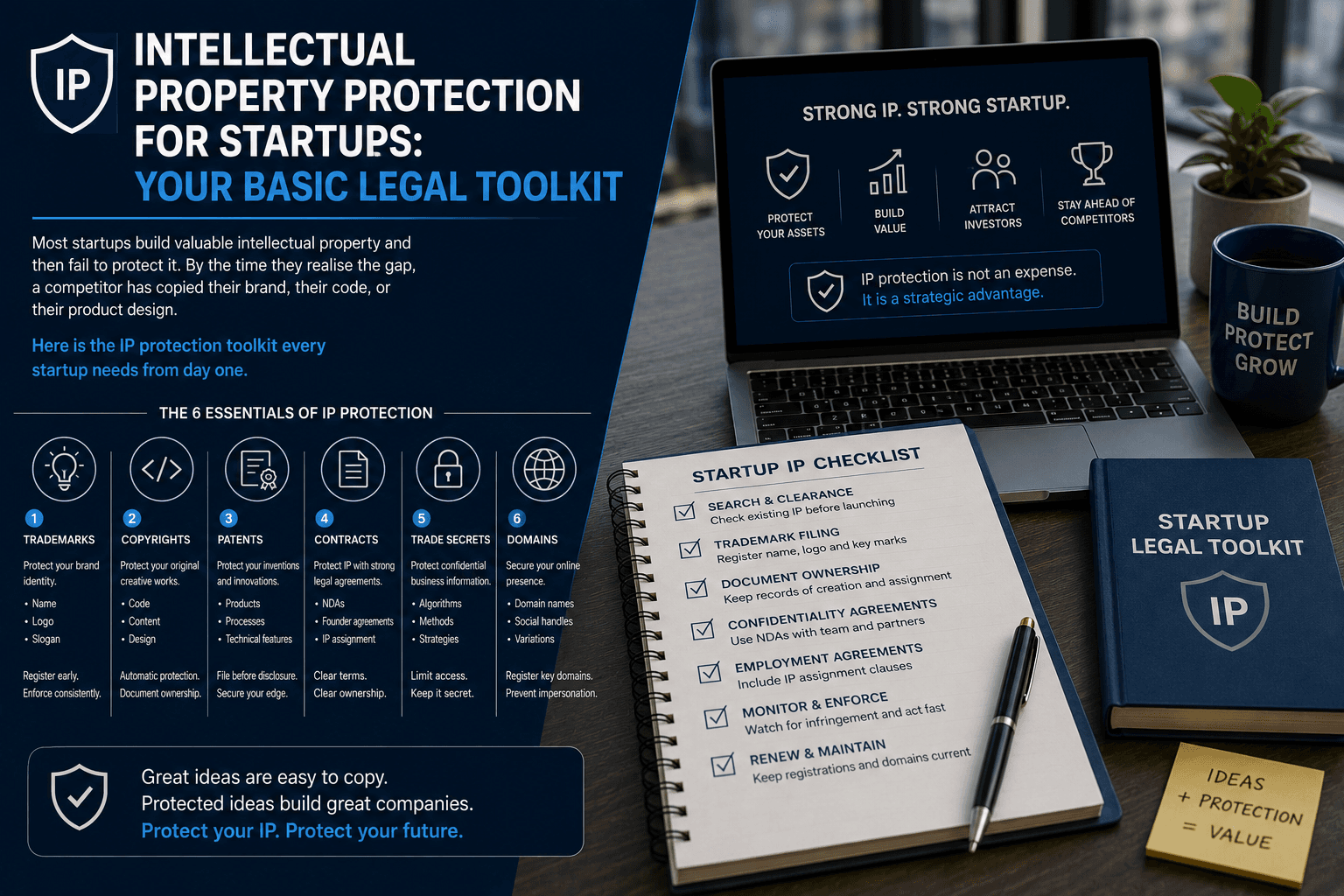
Most startups build valuable intellectual property and then fail to protect it. By the time they realise the gap, a competitor has copied their brand, their code, or their product design. Here is the IP protection toolkit every startup needs from day one.
Your IP Is Often Your Most Valuable Asset — and the Most Exposed
For most tech startups, SaaS companies, and digital businesses, intellectual property is the core of the business. The code, the brand, the product design, the algorithms, the content — all of it is IP. And in the early stages, it is almost universally unprotected.
The consequences range from inconvenient (a competitor using a similar name) to catastrophic (losing the right to use your own product in a key market because someone else trademarked it first).
IP protection is not expensive relative to the losses it prevents. But it must be built deliberately, starting from day one.
The Four Types of IP Relevant to Startups
1. Trademarks
A trademark protects your brand identifiers — your company name, logo, product names, slogans, and any other distinctive signs that identify your business to customers.
What trademarks protect you against:
The critical risk for startups: In most jurisdictions (including the EU, UK, and Cyprus), trademark rights are based on registration, not use. Building a brand for years without registering your trademark means a third party can register it and then prevent you from using it — even in your home market.
EU Trademark (EUTM):
A single application through the European Union Intellectual Property Office (EUIPO) gives trademark protection across all 27 EU member states simultaneously. An EUTM costs approximately €850 for one class of goods/services — covering the entire EU single market.
From February 2025, the EU has been providing funding support for SME trademark registrations through the EUIPO Ideas Powered for Business programme — check whether your business qualifies for a 50-75% cost reduction.
UK Trade Mark:
Post-Brexit, a UK trade mark must be registered separately with the UK Intellectual Property Office (UKIPO). Filing fee from £170 for one class.
Cyprus Trade Mark:
For local protection, register with the Cyprus Department of Registrar of Companies and Official Receiver. EUTM registration also covers Cyprus as an EU member state.
Trademark filing strategy for startups:
2. Copyright
Copyright protects original creative works — software code, written content, website design, graphics, videos, music, and databases.
The key advantage of copyright: In most jurisdictions, copyright arises automatically when an original work is created. No registration is required (unlike trademarks and patents).
The key limitation: Copyright does not protect ideas, concepts, or functionality — only the specific expression of those ideas. Two apps that do the same thing do not infringe each other's copyright simply by performing the same function.
Critical issues for startups:
Who owns the code?
If your software was built by employees: copyright belongs to the employer (in most EU jurisdictions, including Cyprus).
If built by a freelancer or contractor: copyright belongs to the freelancer unless there is a written agreement transferring ownership to you. This is the single most common IP disaster for startups — discovering that the developer who built your product owns its code.
Practical requirement: Every contractor, developer, and designer you hire must sign an agreement that includes an IP assignment clause transferring all rights in work created for you to your company.
Database rights:
EU Directive 96/9/EC protects databases that represent a substantial investment in obtaining, verifying, or presenting their contents. If your startup has built a valuable data asset (customer database, property listings, medical records, etc.), you may have a separately protectable database right.
Software copyright term: Life of the author plus 70 years, or 70 years from creation for anonymous/corporate works.
3. Patents
Patents protect inventions — new, non-obvious technical solutions to technical problems. They grant the holder an exclusive right to make, use, or sell the invention for typically 20 years.
The reality for most startups:
When patents make sense for startups:
For most pure software and SaaS startups, trade secrets are a more practical alternative to patents for protecting core algorithms and processes.
4. Trade Secrets
A trade secret is any confidential business information that provides a competitive advantage — and that you take reasonable steps to keep secret.
Examples relevant to startups:
EU protection: Trade secrets are protected under EU Directive 2016/943 (implemented in all member states, including Cyprus). To qualify for protection, the information must:
What "reasonable steps" means in practice:
The protection lasts as long as the secret is maintained — unlike patents which expire after 20 years, a trade secret can be protected indefinitely.
The IP Ownership Audit: Where Most Startups Find Gaps
Before you can protect your IP, you need to know what you own. A basic IP audit for a startup covers:
1. Who built your core technology?
Check every contractor and developer who wrote code for your product. Do you have signed IP assignment agreements with all of them? If not, you may not own your own product.
2. Is your brand registered?
Search EUIPO TMview for your company name, product names, and any logos. If someone else has registered a similar mark in your classes, you may have a conflict that needs addressing before it becomes a legal dispute.
3. What content have you created?
Your website copy, blog posts, marketing materials, and product documentation are copyright-protected works. Are they clearly marked as your property? Have you taken screenshots/dated evidence of creation where originality might be disputed?
4. What do you keep secret?
List the information that, if a competitor obtained it, would seriously harm your competitive position. Is this information subject to NDAs and access controls?
5. Do your employment contracts include IP assignment?
For employees, check that your contracts include a clause assigning to the company all IP created in the course of employment.
The Startup IP Protection Toolkit — Priority Order
| Priority | Action | Cost | Time |
|---------|--------|------|------|
| 1 | Sign IP assignment agreements with all contractors | Legal fee only | Immediate |
| 2 | Add IP assignment + confidentiality to employee contracts | Legal fee only | Immediate |
| 3 | Search and file EU trademark for company name | ~€850-€1,700 | File now; protection from filing date |
| 4 | Search and file UK trademark if serving UK market | ~£170-£340 | File now |
| 5 | Document trade secrets and implement access controls | Internal effort | 1-2 weeks |
| 6 | Sign NDAs before all sensitive disclosures | Legal fee only | Ongoing |
| 7 | Register domain names defensively (key TLDs) | ~€10-50/year each | Immediate |
| 8 | Assess patent potential with IP lawyer | ~€500-1,000 for assessment | Within 6 months |
The One Mistake That Cannot Be Undone
Launching a brand without checking trademark availability first. Founders invest months building brand recognition, marketing collateral, and customer relationships around a name — only to receive a cease and desist letter from the owner of a registered trademark.
Rebranding after launch is extraordinarily expensive: new domain, new social handles, new marketing materials, lost SEO equity, and customer confusion. A trademark search before launch costs a fraction of a rebrand.
Need IP assignment agreements, NDA templates, or help with trademark filing? Our legal team provides complete startup IP protection packages — from contractor assignment agreements to trademark application support. Delivered in 24-72 hours.
Need Legal Documents?
Get expert-drafted legal documents customized for your business. From NDAs to GDPR policies, we've got you covered.