Legal Document Translation: Why Accuracy Is Everything
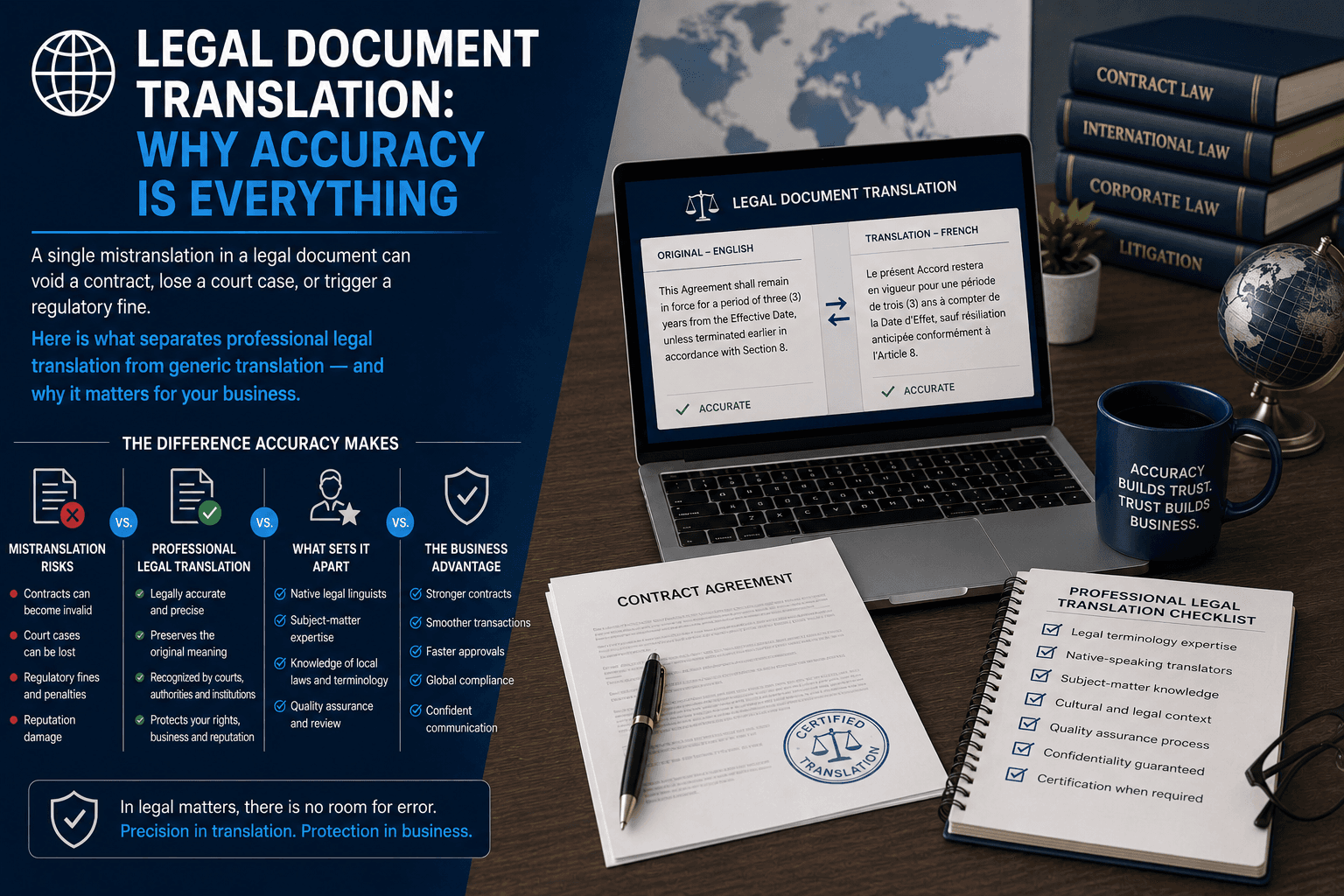
A single mistranslation in a legal document can void a contract, lose a court case, or trigger a regulatory fine. Here is what separates professional legal translation from generic translation — and why it matters for your business.
When One Word Changes Everything
In 1980, a medical interpreter translated the Spanish word "intoxicado" as "intoxicated" instead of its correct meaning: "poisoned." The mistranslation led to an 18-year-old patient being treated for drug intoxication instead of a brain haemorrhage. He survived, but was left quadriplegic. The hospital eventually paid a $71 million settlement.
Legal and official documents carry the same stakes — not always in terms of physical safety, but consistently in terms of financial, regulatory, and legal consequences. A mistranslated contract clause, a misrendered legal definition, a garbled compliance requirement: each one creates liability that far outweighs the cost of getting the translation right.
What Makes Legal Translation Fundamentally Different
Legal translation is not language conversion. It is a specialised discipline that sits at the intersection of linguistics, law, and jurisdiction — and it demands expertise in all three.
The core challenge: Legal systems differ fundamentally between countries. A term that has a precise, well-established legal meaning in one jurisdiction may have no direct equivalent in another, or may carry a completely different meaning.
Examples:
A competent legal translator understands not just both languages but both legal systems — and knows when a literal translation is legally inaccurate, requiring an explanatory addition or a functional equivalent.
When Your Business Needs Certified Legal Translation
Company formation and corporate documents
Cyprus company incorporation documents (Memorandum and Articles of Association, director registers, shareholder certificates) often require certified translation for use in other jurisdictions — for bank account openings, regulatory registrations, or cross-border transactions.
Contracts and commercial agreements
Any contract that will be governed by or executed in another jurisdiction should be translated by a legal professional, not a general translator. The commercial terms must carry the same legal weight in both languages.
Employment contracts for international staff
When employing staff who do not speak your operating language, providing a translation of the employment contract in their language is both a practical requirement and, in some jurisdictions, a legal obligation. The translation must be accurate — an employee cannot be bound by terms they could not understand.
Court proceedings and litigation documents
Evidence, witness statements, legal opinions, and court orders used in foreign proceedings must be certified translations meeting the specific requirements of the relevant court.
Immigration and residency documentation
For Cyprus residency applications, business visas, and work permits, all supporting documents in foreign languages must be officially certified. The Department of Migration requires specific translation standards.
GDPR and regulatory compliance documents
Data Processing Agreements, Privacy Policies, and compliance documentation shared with regulators or cross-border partners must be accurate in all relevant languages. A Privacy Policy that is correctly written in English but poorly translated into Greek may fail regulatory scrutiny in Cyprus.
Intellectual property filings
Patent applications, trademark filings, and licensing agreements submitted to the EUIPO, national IP offices, or foreign courts require translations that precisely capture the legal scope of the IP protection claimed. An inaccurate translation can inadvertently narrow or widen the scope of protection.
What Certified Translation Means
A "certified translation" is a translation accompanied by a formal statement from the translator (or translation agency) confirming:
Depending on the jurisdiction and purpose, additional requirements may apply:
Sworn translation: In many EU member states (including Greece, but not typically Cyprus), translations must be performed by a court-sworn translator registered with the local court. Check the requirements of the receiving jurisdiction before commissioning the translation.
Notarised translation: Some jurisdictions require the translator's signature to be notarised — i.e., verified by a notary public who confirms the translator's identity.
Apostille: For documents to be used in countries that are party to the Hague Convention, an apostille (an authentication stamp from the competent national authority) may be required. In Cyprus, apostilles are issued by the Ministry of Justice and Public Order.
Legalisation (for non-Hague countries): Documents destined for countries that are not party to the Hague Convention require full consular legalisation — a multi-step authentication process.
The 7 Standards of Professional Legal Translation
A professionally translated legal document must meet all of the following:
1. Terminological precision
Every legal term must be rendered with its functional equivalent in the target language — not a literal word-for-word translation but the term that carries the same legal meaning in the target legal system.
2. Completeness
No part of the original may be omitted or summarised. Every clause, footnote, stamp, seal, and annotation must be accounted for, even if it adds length or complexity to the translation.
3. Structural preservation
The format and structure of the original document — numbering, headings, recitals, signature blocks — must be preserved in the translation to maintain document integrity.
4. Consistency
The same term in the source document must be translated consistently throughout. Inconsistent translation of a defined term can create ambiguity that a counterparty or regulator can exploit.
5. Neutrality
The translator must not add, remove, or alter meaning — even unintentionally. Subtle changes in tone, emphasis, or qualification can change the legal effect of a clause.
6. Confidentiality
Legal documents routinely contain commercially sensitive and personally identifiable information. Professional legal translators operate under strict confidentiality obligations and use secure workflows for document handling.
7. Jurisdiction awareness
The translator must understand the legal system of both the source and target jurisdictions. When a term or concept from the source jurisdiction has no equivalent in the target, the translation must include an accurate explanatory note rather than an inaccurate approximation.
The Greek-Arabic Language Pair: A Specific Challenge
Translating between Greek and Arabic — relevant for Cyprus businesses serving MENA clients, or for Arabic-speaking residents and businesses operating in Cyprus — presents specific challenges:
Professional legal translation between Greek and Arabic must be handled by translators with legal training in both systems — not general Arabic-language translators.
What to Look For in a Legal Translation Provider
Before commissioning a legal translation, verify:
Speed without accuracy is worthless in legal translation. A translation delivered in 24 hours that contains a single mistranslated clause may require weeks of legal correction.
Languages We Work With
Our legal translation team handles documents between English, Greek, Arabic, and other languages — with legal expertise in Cyprus, EU, and UK frameworks. All translations are produced by qualified professionals with legal backgrounds and include full certification meeting Cypriot and international requirements.
Need a legal document translated accurately and certified? Contact our team for a quote based on document type, language pair, and required turnaround. We cover contracts, corporate documents, compliance materials, court documents, and immigration paperwork.
Need Legal Documents?
Get expert-drafted legal documents customized for your business. From NDAs to GDPR policies, we've got you covered.