Cyprus Tax Advantages in 2026: What Businesses Need to Know
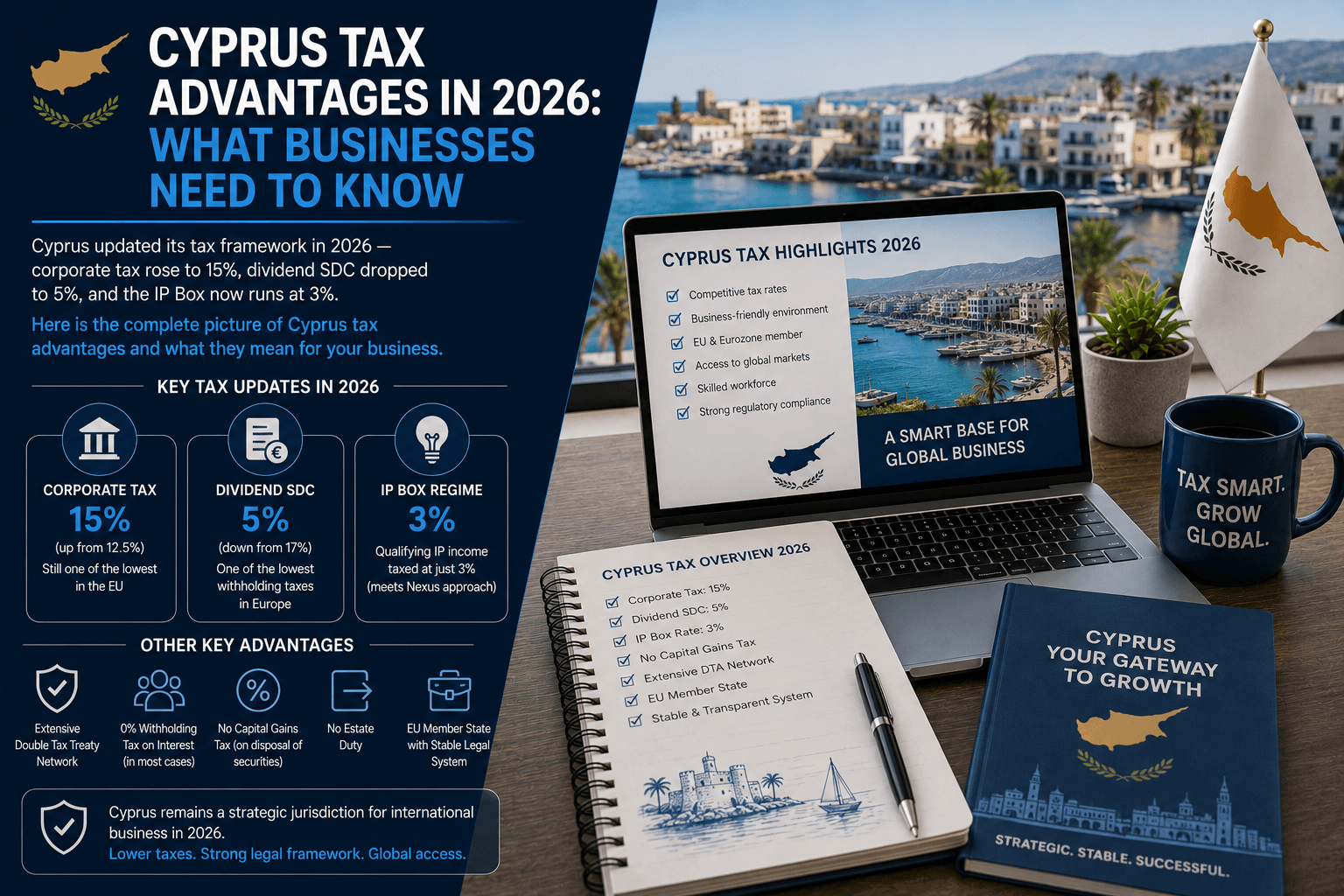
Cyprus updated its tax framework in 2026 — corporate tax rose to 15%, dividend SDC dropped to 5%, and the IP Box now runs at 3%. Here is the complete picture of Cyprus tax advantages and what they mean for your business.
Cyprus Remains One of Europe's Most Attractive Tax Jurisdictions
The Cyprus Tax Reform of January 2026 introduced several significant changes to the tax framework. While the headline corporate tax rate increased from 12.5% to 15% — aligning with the OECD's global minimum tax standard — Cyprus simultaneously introduced new reliefs and simplifications that maintain its position as one of Europe's most competitive jurisdictions for international business.
This guide covers every major tax advantage Cyprus offers in 2026, updated for the new framework.
1. Corporate Income Tax: 15% Flat Rate
Cyprus imposes a flat 15% corporate income tax on worldwide income of Cyprus tax-resident companies.
Key features:
International comparison (2026):
| Jurisdiction | Corporate Tax Rate |
|-------------|-------------------|
| Cyprus | 15% |
| Ireland | 15% (min tax for large companies) |
| Hungary | 9% |
| UK | 25% (19% for small profits) |
| Germany | ~30% (combined) |
| France | 25% |
| Netherlands | 25.8% |
Even at 15%, Cyprus offers one of the lowest flat corporate rates in the EU for companies of all sizes.
2. IP Box Regime: ~3% Effective Rate on IP Income
This is arguably Cyprus's most powerful tool for technology and IP-driven businesses.
Under the Cyprus IP Box:
What qualifies as IP income under the Cyprus IP Box:
What counts as qualifying IP:
The nexus requirement:
Cyprus IP Box compliance requires the "nexus approach" — the company must have conducted genuine R&D activity that created the qualifying IP. IP acquired from a third party or from related parties without substantial development activity in Cyprus does not fully qualify.
This means you need:
Practical example:
A SaaS company with €1,000,000 of qualifying software royalty income:
3. Zero Withholding Tax on Dividends, Interest and Royalties
Cyprus imposes no withholding tax on payments to non-residents (subject to conditions) for:
This makes Cyprus an exceptionally efficient holding company jurisdiction. A Cyprus holding company can receive dividends from subsidiaries and pay dividends to shareholders without withholding tax being deducted at source.
4. Special Defence Contribution (SDC) Reform 2026
The SDC is a tax on dividends, interest, and rental income that applies to Cyprus tax resident domiciled individuals (not companies). The 2026 reform reduced the SDC rate on dividends from 17% to 5% for profits earned from 2026 onwards.
The previous Deemed Dividend Distribution (DDD) mechanism — which imposed SDC on company profits whether distributed or not — has been abolished for profits earned in 2026 onwards.
For Cyprus-domiciled shareholders: The net dividend tax position has significantly improved. Previously, retained profits were subject to DDD at 17% SDC. Now, actual dividends are taxed at 5% SDC with no automatic charge on retained profits.
Non-domicile status:
Cyprus residents who are not domiciled in Cyprus (Non-Doms) are exempt from SDC entirely for 17 years from the date they become Cyprus tax resident. This means Non-Dom Cyprus residents can receive dividends from Cyprus companies with zero SDC — making the effective personal tax on dividend income zero (since Cyprus also imposes no dividend withholding tax).
5. Capital Gains Tax Exemption
Cyprus imposes no capital gains tax on gains from the disposal of:
The only exception is gains from the disposal of immovable property situated in Cyprus, or shares in companies that own immovable property in Cyprus (which are subject to 20% CGT).
Why this matters for founders:
When you sell your Cyprus company — whether to a strategic acquirer or in a partial exit — the gain is not subject to capital gains tax in Cyprus. For a company sold for €5 million with a cost base of €500,000, a €4.5 million gain is completely exempt from CGT.
Compare with the UK, where a founder selling shares would face CGT at 18-28% (Business Asset Disposal Relief reduces this to 10% on the first £1 million of lifetime gains, but thereafter full CGT rates apply).
6. Notional Interest Deduction (NID)
A frequently overlooked Cyprus tax advantage: companies can deduct a Notional Interest Deduction on new equity capital introduced into the business.
The NID rate is set at the 10-year government bond yield of the country in which the new equity is invested, plus a 5% premium — effectively a deemed interest deduction on equity financing.
This rewards companies that fund their growth through equity (shareholder capital) rather than debt, giving a tax benefit similar to interest on a loan without the need to actually borrow.
7. Extensive Double Tax Treaty Network
Cyprus has signed 65+ double tax treaties covering the major jurisdictions relevant to international business. Key treaties include:
These treaties prevent double taxation of income earned in one country by a company or individual resident in another — essential for businesses with cross-border revenues or international shareholders.
8. Stamp Duty Reform 2026
The 2026 tax reform abolished stamp duty on most commercial contracts. Previously, Cyprus imposed stamp duty of up to 0.2% on the value of contracts — a cost that added up significantly for high-value commercial transactions.
This reform reduces transaction costs and administrative burden for businesses entering contracts in Cyprus.
9. The 60-Day Residency Rule
Individuals can establish Cyprus personal tax residency by spending as little as 60 days per year in Cyprus — provided they:
Combined with Non-Dom status (exemption from SDC for 17 years), Cyprus personal tax residency is one of the most flexible and tax-efficient residency arrangements available in Europe.
Legal Compliance Requirements to Access These Benefits
Tax advantages are not automatic. To benefit fully from Cyprus's tax framework, companies must:
Tax authority scrutiny of substance requirements has intensified across Europe. Structures that exist only on paper — without real economic activity in Cyprus — are increasingly challenged by both Cypriot authorities and foreign tax authorities under CFC (Controlled Foreign Corporation) rules.
Need help structuring your Cyprus company to maximise these tax advantages? Our legal team handles company formation, substance documentation, and the legal framework that supports tax-efficient Cyprus structures — working alongside your accountants and tax advisors.
Need Legal Documents?
Get expert-drafted legal documents customized for your business. From NDAs to GDPR policies, we've got you covered.